Negroni Sbagliatos for a crowd

Image courtesy Manhattan Cocktail Classic

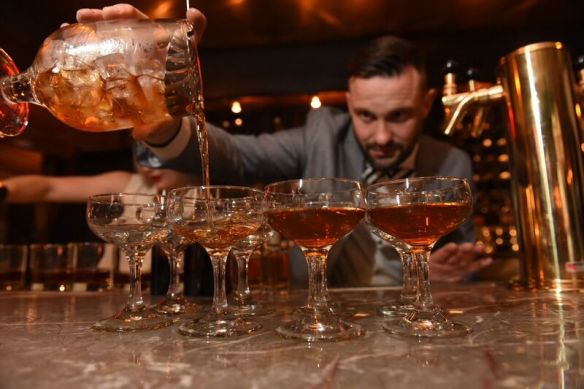
The Manhattan Cocktail Classic has officially drawn to a close. This is one of those epic events where bartenders serve hundreds — in some cases thousands – of cocktails at a go.  There were plenty of mediocre offerings, to be sure. But there were a great many memorable drinks too. And this was perhaps the most memorable drink of them all.

Likely, I was particularly attuned to this drink because of the Cocktails for a Crowd book. No doubt I was paying closer attention than ever before to how batched drinks were presented, ranging from the punch served in painted ceramic punchbowls at Dead Rabbit to colorful pink and orange Palomas decanted into swing-top glass flasks and arrayed on silver platters during a seminar.

But Campari topped them all, offering wee cans of Negroni Sbagliato cocktails. It’s a relatively simple classic cocktail:  Campari, sweet vermouth, and dry sparkling wine, like Prosecco. I first heard of it after Frank Bruni wrote about it a couple of years ago; it started popping up on drink menus shortly thereafter, though it’s still lesser-known vs the Negroni (Campari, sweet vermouth, and gin).  The cans were handed out at the splashy MCC gala, as well as at a party thrown by the brand a couple of nights later.

Apparently, the genesis of this canned cocktail began at last year’s gala, where Negronis were pre-batched, carbonated and bottled. At the event, bartenders merely popped off the bottle caps and inserted a straw. It was on-trend — arguably, ahead-of-trend– fun to drink and speedy to serve. The canned cocktails had been floated for the 2012 gala, a PR rep told me (as we sipped Sbagliatos, natch), but tabled until 2013.

Apparently, a great deal of effort went into those canned cocktails. They had to be specially made, the cocktail had to be made in large quantities, and they had to be shipped over. The red-and-white striped plastic straws (not paper, which disintegrate quickly), were sourced from Etsy.

Everyone noticed them. From a drinker’s perspective, it was a good cocktail — truly, the most important part of this equation — and it was fun to drink, so people actually walked around and drank from the cans. It wasn’t too big and it wasn’t too boozy, so it was one of the few cocktails I actually finished at the Gala. From a marketer’s perspective, it was clearly branded — no mistaking the distinctive Campari red, and it was labeled in big letters anyway, identifying the brand and the name of the drink. It was memorable and everyone asked where to get one. It was clever and not too ostentatious. Even the straws reinforced the branding, but in a tasteful way.

Now here’s where things fall apart. Despite this marketing coup, no one can buy this product. And I heard many people say they would gladly purchase a six-pack of Sbagliatos (I was one of them). You can buy a cans of Pimm’s at convenience stores in the UK, yet in the United States, the Ready-To-Drink category is limited to pouches of awful slushy Margaritas made with fake lime flavoring. If Campari brought the canned Sbagliato product to market, I would consider it to be an outright marketing success. If not, it was just a clever flash-in-the-pan that will need to be topped again next year.

2 Comments

Filed under bar techniques, Cocktails for a Crowd, Drink trends, Uncategorized

4 Batching Secrets from the Cocktail Pros

Rounds of peel cut from oranges during prep for Manhattan Cocktail Classic

As of this week, Cocktails for a Crowd is officially out there in the wild!

As I’m gearing up for the Manhattan Cocktail Classic this coming weekend and many of my favorite bartenders are winging their way into town, I’m thinking about one of my favorite parts of working on the book:  gathering advice (and recipes) from bartenders.

By design, this book owes a lot to mixologists. Many of the recipes are bartender originals, of course. But I got a kick out of asking bartenders to spill their secrets about batching (creating large batches of drinks), which often happens behind the scenes at events, cocktail conferences (like MCC) and bars, too.

Here are some of my favorite tips — some of this info is in the book, some not.

You can never have too much ice. That’s not a secret, of course. But Portland bartender Kelley Swenson explained how to figure out how much ice is enough:  for each 750 milliliters (3 1/4 cups) of cocktail (the size of a standard bottle of liquor), allot 7 pounds of ice.   Another useful metric: allot 1 to 1.5 pounds of ice per person. Either way, get what you need and then get some more, because (say it with me!) you can never have too much ice.

Mise en place is your best friend. The French culinary term mise en place means “putting in place.” If you’re throwing a soiree, before your guests arrive, put everything you’re making drinks with in place.  EVERYTHING! Squeeze the citrus, set the glassware where you can reach it, make sure you have all the liquor you need (and all the ice too)! When you go to a bar early in the evening and they’re bustling about even though you’re the only guest at the bar, that’s what they’re up to back there — mise en place. You should do it too.

Control the dilution. Watery drinks suck. This is one reason bartenders consider their ice so carefully. If you can use a large block of ice to chill a punch or even a pitcher of drinks, that’s ideal. It melts more slowly than a handful of ice cube tray ice cubes, which seem to dissolve in record time while your guests are still shrugging off their coats.

Jason Asher, head mixologist at Young’s Market of Arizona, was one of the first to flag for me that for batching purposes, you can add the water yourself, and then chill a drink in the refrigerator or set it on ice. “My rule of thumb is 25% to 30% water comes from dilution” caused by shaking a cocktail, he explained. (I worked with 20% to 25% as my baseline for the drinks in the book.) “For a stirred cocktail, I like to add ice, then stir it, taste it, and when it hits the right amount, then strain the ice out.” You wouldn’t want to do this too far in advance — but a few hours ahead, and it works beautifully.

Learn how to make oleosaccharum. I swear it’s the difference between a good punch and a great punch. Try it and see.  In brief, you muddle citrus peel with sugar, and then the magic ingredient is time. Wine Enthusiast recently published an oleosaccharum primer if you’d like more how-to detail.

Thanks for the advice, barkeep!

Leave a Comment

Filed under bar techniques, Cocktails for a Crowd

Introducing my new book – Cocktails for a Crowd!

Cocktails_for_a_Crowd_COVEROn May 14, my new book, Cocktails for a Crowd, will officially hit the shelves!

This one has been in the works for a while. It’s all about batching cocktails for large groups — a concept that professional bartenders know well, but few at-home bartenders do.  If you’ve never heard of “batching” before, it’s what goes on behind the scenes at cocktail conferences and other events:  I have seen bartenders stirring up drinks for 200 people in giant plastic vats, stirring with what look like rowboat oars….and yet, when they’re dispatched into glasses and garnished with care, it looks (and tastes) like the drink was painstakingly made just for one.  So I asked some of the smartest bartenders I knew how that gets done — and how people can do it at home.

This book, which spans punches, pitchers, bottled cocktails and other large-format drinks,  includes updated classics as well as original cocktails from bartenders. (PS, I think this may be the first book to include a range of bottled cocktails!) The lovely photos were taken by Teri Lyn Fisher. I’m going to highlight some of my favorite drinks and techniques in coming weeks.

If you want to be one of the first to get your hands on a copy, it’s available for pre-order now. Perhaps you’re already thinking about summer entertaining or thinking about host/hostess gifts  – if so, I hope you’ll pick up a copy. Cheers!

Leave a Comment

Filed under Cocktails for a Crowd

Celery-spiked cocktail recipe: Green Hornet

My article, “Put A Stalk In It,” about celery-spiked cocktails, is in the May/June issue of Imbibe Magazine.

Although it may seem like an obscure ingredient for cocktails, once I started looking around, I found myself spotting celery everywhere, in various forms. Erick Castro has a Paloma riff at his new bar, Polite Provisions, subbing Dr. Brown’s Cel-Ray soda in place of grapefruit Jarritos. Celery foam tops Bloody Marys.  A Celery Gimlet is on the menu at Saxon + Parole, one of my new favorite bars — with celery juice and Maldon sea salt. Celery shrub here. Celery bitters there. Celery seed-infused syrups. Housemade celery cordial at Dead Rabbit. In researching a separate article on Rock & Rye, I came across a 1902 reference to “La Rue’s Celery Rock & Rye.”  

It’s enough to make you want a good drink.  So here’s one to try. Although it didn’t fit into the Imbibe article, it’s a mighty refreshing cocktail nevertheless.

Green Hornet

Tona Palomino, Trenchermen, Chicago, IL

The menu description reads simply:  celery gin and tonic. “A lot of people thought it was celery gin,” notes Palomino. “Rather, it’s a celery-flavored gin and tonic.”

1.5 oz. gin

1.5 oz. fresh celery juice

3/4 oz. simple syrup

3/4 oz. lime juice

I dash  Bitter Truth Celery Bitters (optional)

1 oz.  tonic water

Measure everything but the tonic water into a cocktail shaker. Cover with ice and shake. Strain into a 12-ounce Collins glass filled with fresh ice. Top off with the tonic water.

Leave a Comment

Filed under Drink recipes, Drink trends, My writings

Talking and tippling with the 3 “Vermouth-kateers”

The "Vermouth-kateers":  Carl Sutton, Neil Kopplin and Andrew Quady

The “Vermouth-kateers”: Carl Sutton, Neil Kopplin and Andrew Quady

Julia Child splashed French vermouth into much of her cooking. James Bond added Italian vermouth to his famous “shaken, not stirred,” martinis. But American-made vermouth is what’s now taking the cocktail world by storm.

So on April 8, it was my pleasure to moderate a panel of West Coast wine and vermouth producers, “Fountain of Vermouth,” at the International Association of Culinary Professionals conference in San Francisco.

The three panelists- who jokingly refer to themselves as “vermouth-kateers“-  were Neil Kopplin, a former bartender and current partner of Portland, Oregon’s Imbue Cellars, who makes his Bittersweet Vermouth with Willamette Valley Pinot Gris; Carl Sutton, owner of Sutton Cellars in Sonoma, Calif.; and Andrew Quady, a Madera, California-based winemaker who also produces vermouth under the Vya label.

Quady first provided the attendees with a definition of the aromatized, fortified “wine-but more than just wine,” including an overview of some of the botanicals used to flavor it.

That was followed by a lively debate between Kopplin and Sutton, who have divergent philosophies about what makes for good vermouth. Sutton said he starts with both wine and brandy that is “absolutely neutral” in character: “I want a completely blank canvas, something I can project onto.” He then adds as many as 17 ingredients for flavoring.

Kopplin, for his part, insisted that since the wine makes up 75-80% of what’s in the glass, it should be “the bright shining star” that the botanicals are selected to complement. He fully expects his vermouth to change from year to year, he added, since he switches up the base wine with each vintage. This year, he’s using local Pinot Gris; next year, the base will be Sémillon.

To cap it all off,  Sutton mixed up a round of Bamboo cocktails for the crowd – here’s the recipe:

Bamboo Cocktail

1½ oz. Lustau amontillado sherry

1½ oz. Sutton Cellars dry vermouth

2 dashes orange bitters

1 dash Angostura bitters

Stir together all ingredients with ice, and strain into a cocktail glass.   Garnish with a lemon peel twist.

Leave a Comment

Filed under Drink recipes, Drink trends, Classes and seminars, On the road

History or hooch? Chicago – I’m coming your way!

 Chicago area friends:  I’m so excited to be heading to the Windy City next week! Here’s my schedule – whether your taste runs to history or hooch, please mark your calendar.  I hope to see you while I’m in town.

Monday, April 22:  Lecture on The Secret Financial Life of Food, with the Culinary Historians of Chicago. 

I’ll be giving a talk about my book, The Secret Financial Life of Food, at an event presented by The Culinary Historians of Chicago.

Since so much of agricultural commodities history took place in Chicago, I’m especially thrilled to have an opportunity to talk about grain, cattle and other food-related futures here. And I fully expect to learn a thing or two from this particular group!

Location:  Kendall College (900 N. North Branch St., Chicago, IL)  at 6:30 pm.

Tuesday, April 23: Drink.Think heads to Chicago!

I’ll be hosting Drink.Thinka literary reading event about all things drink. Come out and hear your favorite Chicago-area beverage and food writers read from their work. We have a great line-up of writers, authors and industry pros coming out for the event. Admission is free, plus we’ll have some complimentary whiskey tipples on hand. (Win-win!)

Location:  Tavernita, 151 W. Erie St, Chicago, IL. Come out at 6pm to drink; the reading starts at 7pm.

See you in Chicago!

Leave a Comment

Filed under Classes and seminars, On the road, The Secret Financial Life of Food, Uncategorized

IACP winner!

iacpI was pretty darn excited to learn that I’d been named a finalist for the Bert Greene Award in the “Writing About Beverages” category, a prestigious award given by the International Association of Culinary Professionals.

And I really didn’t think I had a shot at winning. This is not false modesty — I truly thought that the biggest name in the category was likely to be the one to take it all home.  When I flew out to San Francisco to attend the conference, I tried not to think about it. During the conference, I was so immersed in planning my “Fountain of Vermouth” panel and the general intensity of meeting and greeting, so it was really easy to forget about the awards. And then Tuesday night arrived, and I gamely put on my little black dress and expected to clap for the other guy, like a good sport.

And then they called my name. In fact, it turned out to be a tie! In the end, the scores meant that Seattle Weekly’s Mike Seely and I both won. I loved his piece (Murray Stenson’s Accidental Tourists), so I’m happy to share this honor with him. I was just sorry that he wasn’t there to celebrate with me over a drink – guess I’ll just have to take a raincheck.

2 Comments

Filed under Uncategorized